
Unable to Connect to Server Checkpoint R80

Unable to Connect to Server Checkpoint R80
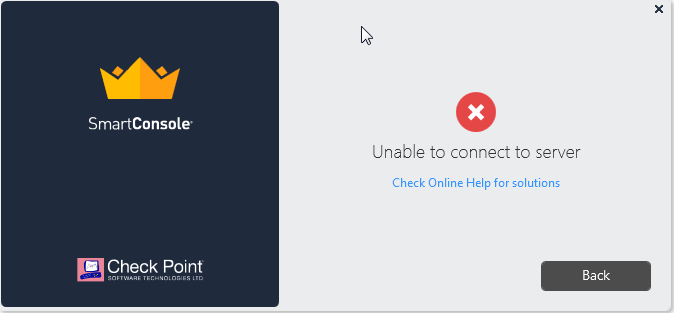
Unable to Connect to Server

A connection to the management server will fail if:
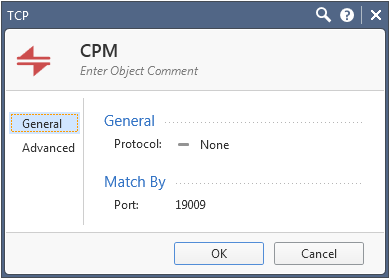
  • A firewall between SmartConsole and the management server blocks Port 19009 - port 19009 is used for a new R80 service. Allow traffic on this port for all clients and management servers.
  • No GUI clients are assigned - Open the Gaia Portal.
    • If the First Time Configuration Wizard opens, complete it.
    • If the First Time Configuration Wizard has already run, open User Management > GUI Clients and add a client.
      When using Multi-Domain Security Management, connect SmartConsole to the Multi-Domain Server and make sure the domains have GUI clients assigned to them.
  • The required processes are not reachable - Make sure the computer with SmartConsole installed can reach the IP address of the management server, and that these server processes are up and running:
    • cpm
    • fwm
  • Operation time out – Your connection to the management (cloud demo or network server) might be slow or blocked. Check network settings, and try again.

Comments

Popular posts from this blog

CLI Commands for Troubleshooting FortiGate Firewalls

CLI Commands for Troubleshooting FortiGate Firewalls 2015-12-21 Fortinet , Memorandum , Network Cheat Sheet , CLI , FortiGate , Fortinet , Quick Reference , SCP , Troubleshooting Johannes Weber This blog post is a list of common troubleshooting commands I am using on the FortiGate CLI . It is not complete nor very detailled, but provides the basic commands for troubleshooting network related issues that are not resolvable via the GUI. I am not focused on too many memory, process, kernel, etc. details. These must only be used if there are really specific problems. I am more focused on the general troubleshooting stuff. I am using it personally as a cheat sheet / quick reference and will update it from time to time. Coming from Cisco, everything is “show”. With Fortinet you have the choice confusion between show | get | diagnose | execute . Not that easy to remember. It is “ get router info6 routing-table” to show the routing table but “ diagn...

From MPLS to SD-WAN to SASE: An Evolution of Enterprise Networking

From MPLS to SD-WAN to SASE: An Evolution of Enterprise Networking The way we do business is changing. As critical business applications migrate to the cloud, and the mobile workforce continues to grow, networking and security solutions need to evolve in order to meet the changing business needs. Gartner believes (and we agree) that the future of networking lies with  SASE (Secure Access Service Edge)  – the convergence of networking and security into one cloud service. Here’s why. 1990s – 2000s: MPLS and the Era of Clear Network Boundaries? Back in the day, networking models were hardware-centric and manually configured. Applications, data, and services lived within private datacenters and relied on remote access solutions to connect remote workers. Dedicated network connectivity, known as MPLS, was the preferred approach for connecting remote locations. MPLS provides predictable performance, low latency and packet loss, and central management. However, MPLS is ...

FortiGate: Upgrading the firmware via CLI

FortiGate: Upgrading the firmware via CLI To use the following procedure, you must have a TFTP or FTP server that FortiDB can connect to. You must also log in using the “admin” administrator account. Start the FTP or TFTP server. Copy the new firmware image file to the FTP or TFTP server. Log into the CLI. Verify that FortiDB can connect to the FTP or TFTP server. For example, if the IP address of the TFTP server is 192.168.1.168, enter the CLI command: execute ping 192.168.1.168 Enter the following command to copy the firmware image from the TFTP server to FortiDB: execute restore image ftp execute restore image tftp Where is the name and location of the firmware image file and or is the IP address of the FTP or TFTP server. For example, if the firmware image file name is image.out and the IP address of the FTP or TFTP server is 192.168.1.168, enter: execute restore image tftp image.out 192.168.1.168 FortiDB responds with the message: This oper...